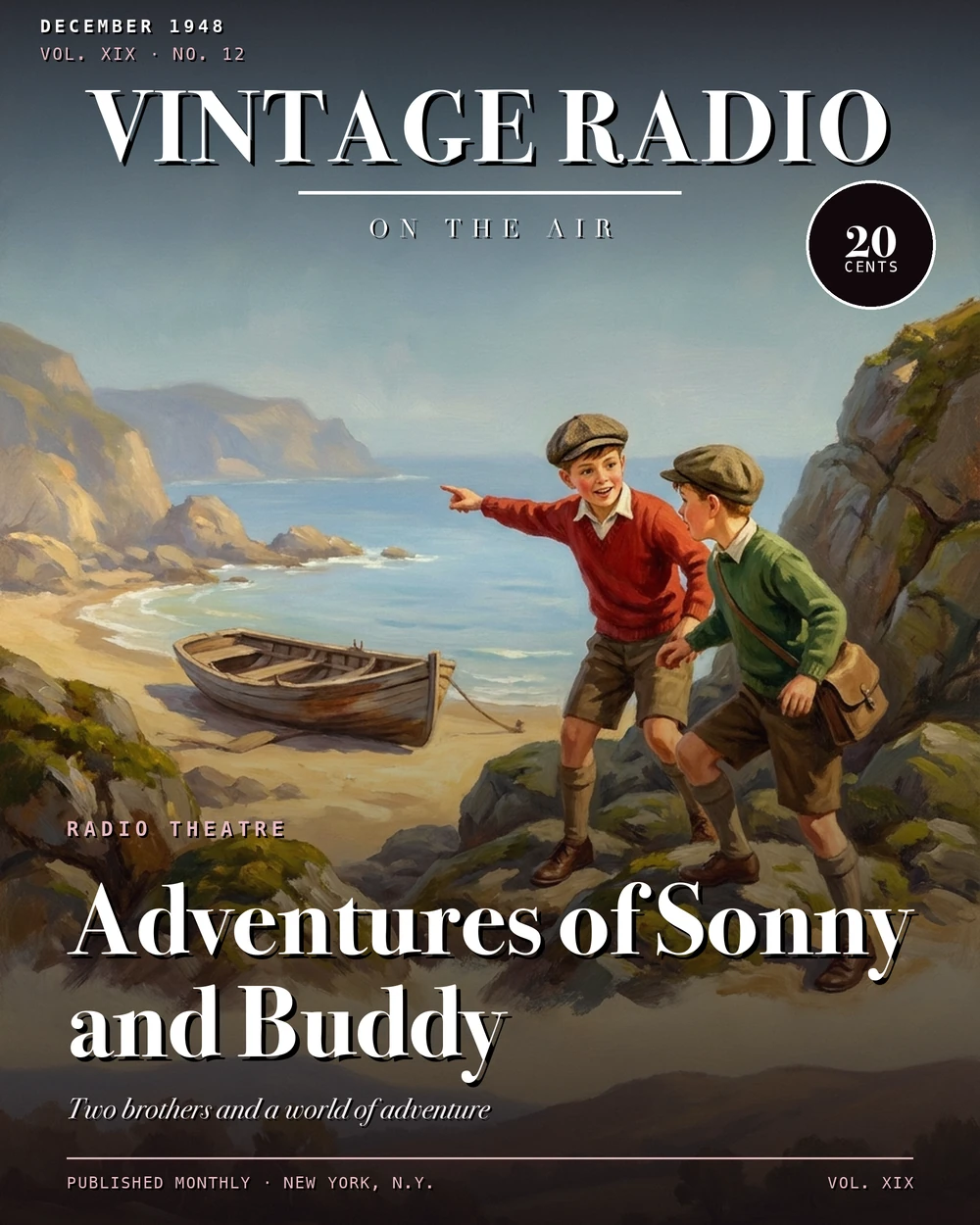
The Adventures of Sonny and Buddy
A Family Business on the Air
What sets The Adventures of Sonny and Buddy apart from most children's adventure serials of the 1930s isn't just the stories — it's who was making them. The show was a genuine family operation from top to bottom. Scripts came from Edna Park, a stage actress who wrote each episode for her own sons to perform. The two title characters, Sonny (age 13) and Buddy (age 14), were played by real-life brothers Jack Edwards Jr. and Sam Edwards. Their father, Jack Edwards Sr., stepped in to voice most of the adult male roles. The producing entity was Park-Edwards Productions, named for the family itself. In an era when radio production was increasingly industrialized, this was a show built around a single performing family that had already spent years together on the vaudeville circuit as "The Five Edwards," touring the Southwest before making the transition to radio.
That vaudeville background shows in how the show was put together. Each weekly episode included Jack and Sam singing popular songs alongside the adventure storylines — an unusual blend that gave the serial a warmer, more variety-show feel than strictly plot-driven programs of the same type. The result mixed humor and excitement in roughly equal measure, with lively dialogue and sound effects carrying the action.
How It Got on the Air
The show's history runs in two distinct phases. The first was a live run in 1933–1934, originating in San Antonio, Texas and rebroadcast in Shreveport, Louisiana. That earlier run established the format and built enough momentum for the family to take a bigger step. Starting in 1935, the show moved to live broadcasts over KFSD in San Diego, with those broadcasts simultaneously recorded at RCA Victor Studios in Hollywood for national distribution. That syndicated run, which the catalog's 46 known episodes represent, ran from January 6, 1935 through November 30, 1936.
Distribution was handled by the Walter Biddick Company, a radio syndicator that managed other serials of the era. The arrangement made The Adventures of Sonny and Buddy one of the first radio serials ever to be syndicated for national distribution — a genuinely early entry in a format that would later become standard practice in American radio. Park-Edwards Productions was a small operation by any measure, but what it launched was something the industry would eventually build an entire model around.
One detail sticks out from the production history: a one-off broadcast was arranged from Havana, Cuba, specifically so that Sam Edwards's grandmother could hear him perform. That kind of personal gesture, worked into the logistics of a syndicated radio operation, says something about what kind of enterprise this was.
Sonny, Buddy, and the Road They Traveled
The two central characters weren't just a generic duo. Sonny was the adventurous one — sometimes reckless, willing to charge into situations where caution might have served him better. Buddy was the more careful of the two, but loyal enough to follow Sonny into whatever trouble presented itself. That dynamic gave the scripts a natural source of tension: one character pushing forward, the other pumping the brakes, and both of them needing to think their way out together.
The central plot arc sent them away from home and into the orbit of a traveling medicine show. The operator, known as Doc, traveled with his daughter Betty and a helper named Charcoal. That mobile setting gave the writers room to move the boys through different environments and different problems — kidnappings, robberies, and treasure hunts among them. The episode titles in the catalog give a sense of how the storytelling worked: Sheriff Gets the Drop, Cornered, The Face at the Window, and Chasing Checkered Suit suggest the crime and chase plots, while Lion Is Loose and Lion Is Captured point to a multi-part animal-escape storyline. House Boat and House Boat Is in a Torrent indicate a water-based adventure that stretched across more than one broadcast. A recurring sheriff character threads through several episodes, a law-enforcement presence the boys apparently kept crossing paths with.
Each episode was largely self-contained, so a listener who missed a week wasn't entirely lost — but the recurring characters and serialized threads rewarded those who stayed with it.
What Happened to the Edwards Brothers
The end of the syndicated run in November 1936 wasn't the end of the Edwards family's radio work. The success of Sonny and Buddy led directly to a follow-up program, The Edwards Family, which kept the troupe working together on air. But the brothers eventually moved into work that took them well beyond the family serial format.
Sam Edwards is probably best known today for voicing the adult Thumper in Disney's 1942 animated film Bambi — a role he took as a young man not long after the radio serial ended. He also later played banker Bill Anderson on the television series Little House on the Prairie, giving him a career that stretched from 1930s children's radio all the way into 1970s prime-time television. Jack Edwards Jr.'s path took him into animation work as well: when Mel Blanc fell ill in 1961, Jack stepped in to take over the voice of Speedy Gonzales. Both brothers also appeared together in the East Side Kids film series in 1940, which meant the on-screen partnership audiences had heard on radio translated into film work not long after the serial ended.
Edna Park, who wrote the scripts, had come from a background in stage acting. Jack Edwards Sr., who voiced the adult roles, had been part of the same vaudeville troupe. The whole family ended up with careers that reflected how naturally they had taken to performance — radio was one stop, not the whole journey.
Where It Sits Among 1930s Adventure Serials
The show shared territory with programs like Air Adventures of Jimmy Allen, Captain Midnight, and The Challenge of the Yukon — adventure serials aimed at younger listeners, built around quick-thinking protagonists in high-stakes situations. What made Sonny and Buddy a little different was the combination of factors that rarely lined up in the same production: child performers playing child characters, a mother writing scripts tailored to her own sons' voices, a father handling the supporting adult roles, and the whole package going out through one of the earliest syndication arrangements in the medium.
The 46 episodes in the catalog represent what survives from that 1935–1936 Hollywood recording run — enough to hear how the formula worked, how the two boys handled the back-and-forth of their characters, and how a vaudeville family translated their act into a children's adventure serial at the moment when syndicated radio drama was still figuring out what it could be.